How task-level semantic search cut Archaius Creative's quote turnaround to under 2 minutes
Quoting took 4+ hours and still depended on who you asked. Now it takes 2, and the answer is always the same.
A quoting process built on memory and guesswork
Archaius Creative is a video production studio that has spent years building a reputation for high-quality editing, motion graphics, color, and audio work. Every completed project meant more experience to draw from.
Archaius had hundreds of completed projects, logged hours, and detailed time-tracking sitting in their system. The problem was getting to it.
Every new inquiry meant 4+ hours of manual digging through old files, trying to piece together comparable work from memory. And because there was no system anyone could draw from, the number you got depended entirely on who built it.
It wasn't just slow. It was also fragile. The studio's best estimating instincts lived in a few people's heads, buried alongside years of project data trapped in free-form descriptions that nothing could search. As inquiry volume grew, so did the inconsistency.
A two-phase build that delivered a live quoting engine
Agent Loopr's foundation was Archaius's underlying data. The entire build followed a single principle: Turn 300 finished projects into a search engine that replicates how the studio's best estimator actually thinks, powered by Claude (claude-sonnet-4-6).
Custom Teamwork MCP server, built with Claude Code
Rather than relying on manual exports, Agent Loopr built a real MCP server, Anthropic's own protocol for connecting AI systems to external tools, directly into Archaius's existing Teamwork system. The server was built using Claude Code and pulled the studio's complete project history and time-tracking records out cleanly, automatically, and in full.
Full history
Pulled from Teamwork via a purpose-built MCP server.
Data audit and quote variable definition
Every project record was reviewed to understand what existed and where the gaps were. From there, the variables that genuinely determine project cost were identified: runtime, complexity, scope, client-supplied assets, and task-level breakdowns across editing, motion graphics, color, and audio.
5 variables
Runtime, complexity, scope, assets, and task-level breakdowns.
Full history restructured into a two-layer dataset
The entire project history was reorganized into a project table linked to a task table. Details buried in free-form descriptions were pulled out and mapped into consistent, searchable fields, giving the system a clean and reliable foundation to work from.
2 layers
Projects linked to tasks, every field consistent and searchable.
Six-agent pipeline turns raw notes into structured signal
The extraction layer runs as a sequence of specialized agents, data preparation, extraction, filtering, categorization, verification, and human-in-the-loop review. Claude reads each project's raw notes the way an experienced estimator would, pulling out the fields that actually drive a quote.
6 agents
Prep, extract, filter, categorize, verify, and human review.
Task-level semantic search with Claude and Qdrant
The matching engine searches across individual tasks, not just whole projects. Embeddings stored in a Qdrant vector database surface genuinely comparable work, regardless of which project it originally came from.
Task-level
Qdrant embeddings surface comparable work across projects.
Claude handles the scoring and reasoning layer
Matching isn't just keyword similarity. Claude weighs how closely each past task resembles the new one, discounts outlier “nightmare projects,” favors recent work, and scales its reasoning by task type, since a longer runtime affects editing far more than motion graphics.
Reasoned, not keyword
Weighted by similarity, recency, and task type.
An evaluation harness keeps Claude's output honest
Every extraction is scored against verified historical actuals, field by field, measuring how closely Claude's output matches the real numbers from past projects. The team trusts the system's accuracy because it's tested, not assumed.
Tested, not assumed
Scored field-by-field against verified historical actuals.
Team-wide quoting interface with full transparency
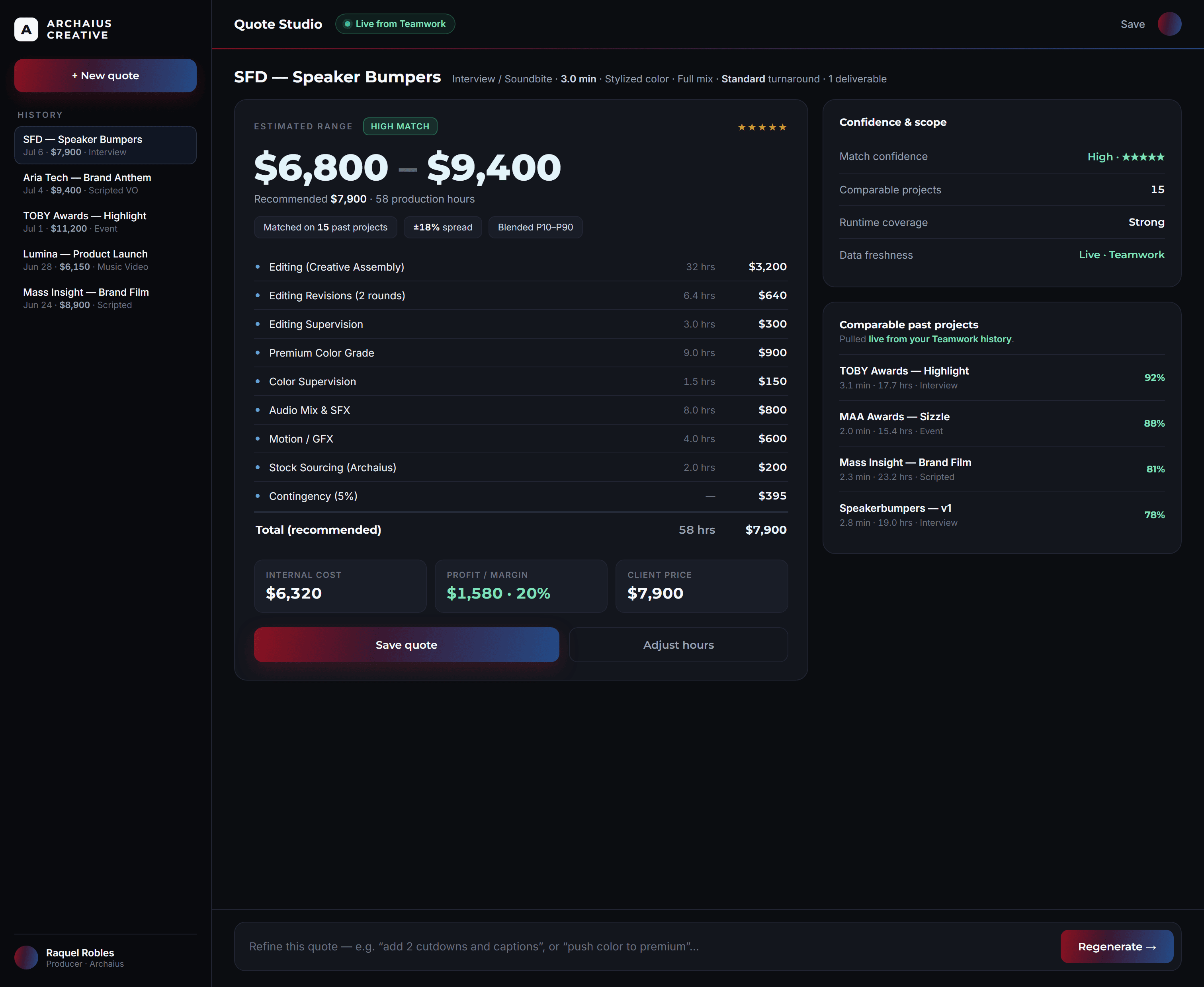
A clean FastAPI-backed web interface brings the whole system together. Any team member can enter a handful of project details and receive a task-level hour breakdown in seconds. Every estimate shows exactly which past projects and tasks it drew from, so the output is auditable and open to human judgment.
Seconds, auditable
Task-level breakdown with a trail back to comparable work.
What changed when 300 projects started working for them
4+ hours to under 2 min
A process that used to pull someone off billable work for 4+ hours now finishes in under 2 minutes, for any team member using it.
Accurate to within ±10%
Every estimate is grounded in Archaius's verified project history. Backed by an evaluation harness that scores Claude's output against real historical numbers, the studio can now send clients figures they can stand behind.
300+ projects now queryable in seconds
Years of finished work that lived in free-form descriptions and individual memories became a structured, searchable asset. Every new project added makes the engine sharper.
1 source of truth
Estimates no longer depend on the estimator. Any team member runs the same query and receives the same defensible output, with a clear trail back to the comparable work behind every number.
Its been an absolute pleasure working with the Agent Loopr team. They consulted us on the best approach to get our quotation tool built, broke down the project into manageable phases for us to review and approve and helped made sure all our needs/requirements were taken care of. They are super professional in their delivery and are real experts on AI systems.
Tools and technologies
used on this project
AI & Retrieval
Reasoning, embeddings, and task-level semantic search.



Backend & Data
A typed API over a structured, two-layer project dataset.


Source & Deploy
Project data in, a live quoting engine out.


One coherent stack: extraction, retrieval, and reasoning, grounded in real project history.