Path A · Scaling
Agentic Infrastructure Studio
We build the AI infrastructure that works in real workflows
We combine agentic architecture with your business context to make it stick.
Start here
Which situation do you resonate with the most?
Path B · Building new
I want to introduce AI into operational workflows
This Is MeThe problems we solve
The problems that usually bring founders to Agent Loopr
Your team sees the potential in AI, but turning isolated tools into reliable workflows is harder than expected.
I've tested a few AI tools, but nothing has become part of the actual workflow.
Different teams are using different AI tools with no real system behind them.
I know there are processes AI could improve, but I don't know where to start.
Some automations save time, but they still need constant manual oversight.
What we do
Our Agentic Infrastructure services
We map your actual workflow first. We design the agent and orchestration architecture against it before any agent goes live.
RAG Pipelines
We build retrieval systems that give AI models reliable access to your business knowledge and operational data.
What we build
- Retrieval systems for internal docs
- Structured pipelines for accurate responses
- Search layers for copilots and agents
- RAG built for evolving data
What you get
- Accurate responses grounded in knowledge
- Reduced hallucinations and missing context
- Faster retrieval across large datasets
- Systems that improve as data evolves
Service 01
RAG Pipelines
We build retrieval systems that give AI models reliable access to your business knowledge and operational data.
What we build
- Retrieval systems for internal docs
- Structured pipelines for accurate responses
- Search layers for copilots and agents
- RAG built for evolving data
What you get
- Accurate responses grounded in knowledge
- Reduced hallucinations and missing context
- Faster retrieval across large datasets
- Systems that improve as data evolves
Service 02
LLM Integrations
We connect language models to your product and internal systems through clean, dependable integration layers.
What we build
- Integrations across internal and customer tools
- AI workflows connected to business systems
- Prompt orchestration and model routing
- Secure links between LLMs and data
What you get
- AI embedded into existing products
- Consistent model behavior across systems
- Secure access to data and apps
- A scalable foundation for AI
Service 03
MCP Servers
We build Model Context Protocol servers that give agents secure, structured access to your tools and data.
What we build
- MCP servers for internal tools and APIs
- Integrations between AI and platforms
- Context-sharing across workflows and agents
- Secure access layers for external data
What you get
- Direct access between AI and tools
- Shared context across agents and platforms
- Fewer bottlenecks as systems grow
- Greater control over AI's data access
Service 04
AI Agent Architecture
We design agent systems that plan, act, and recover reliably.
What we build
- Multi-agent orchestration frameworks
- Sub-agents for specialized tasks
- Agent infrastructure for APIs and databases
- Context and memory layers for agents
What you get
- Agents built around business responsibilities
- Clear orchestration across agents and tools
- Reliable execution across decision chains
- Architecture built for future expansion
Service 05
Workflow Automation
We turn manual, repetitive operations into supervised AI workflows your team can actually trust.
What we build
- Automations across internal tools and systems
- n8n infrastructure for scalable automation
- Multi-step flows with approvals and fallbacks
- Integrations across APIs, databases, and workflows
What you get
- Less dependency on manual execution
- Consistent behavior across workflows
- Greater visibility into activity and failures
- Automation built to scale with you
Service 06
Data Enrichment Engines
We build pipelines that clean, structure, and enrich your data so AI systems have something reliable to work with.
What we build
- Lead enrichment linked to external data
- Automated research for sales teams
- Enrichment engines powered by APIs and AI
- Multi-source systems with structured output
What you get
- Structured data from multiple sources
- Richer intelligence without fragmented tooling
- Consistent enrichment across large datasets
- Pipelines that stay reliable at scale
How we buildOur workflow for
Our workflow for
reliable AI systems
Typical systems are deployed in 3–8 weeks, depending on complexity.
Discovery call
We start by understanding the business problem behind the AI request, not just the tooling.
Use case mapping
We identify which workflows the system should own and what success looks like operationally.
Architecture design
We define the models, integrations, guardrails, and infrastructure behind the system.
Build
We develop the agents, automations, and integrations around real operational requirements.
Integration testing
We test the system inside the client's actual workflows, tools, and operational environment.
Adoption support
We work closely with the team to ensure the system is adopted and delivering operational value.
Launch & monitoring
We deploy the system with observability, monitoring, and production oversight in place.
The comparisonWhy are companies
Why are companies
choosing Agent Loopr for AI systems?
FreelancersGood for isolated automations and short-term implementation work. You usually manage the architecture, integrations, and decisions yourself. Fast to start; harder to operationalize reliably | Agent LooprBuilt for companies that need AI workflows connected cleanly across tools, teams, and operations. You get direct access to the technical team building the systems, integrations, and automations. Tangible progress in a few weeks | Traditional AgenciesGood for larger organizations with longer procurement and delivery cycles. Communication often moves through multiple layers before technical decisions get made. Structured delivery, but typically slower to adapt |
Tech stack
Tools We Use
We build on the full Anthropic stack alongside orchestration, automation, and MCP infrastructure designed for production systems.

Case studyA production-ready
A production-ready
build, shipped to last
Hot InboxRead More
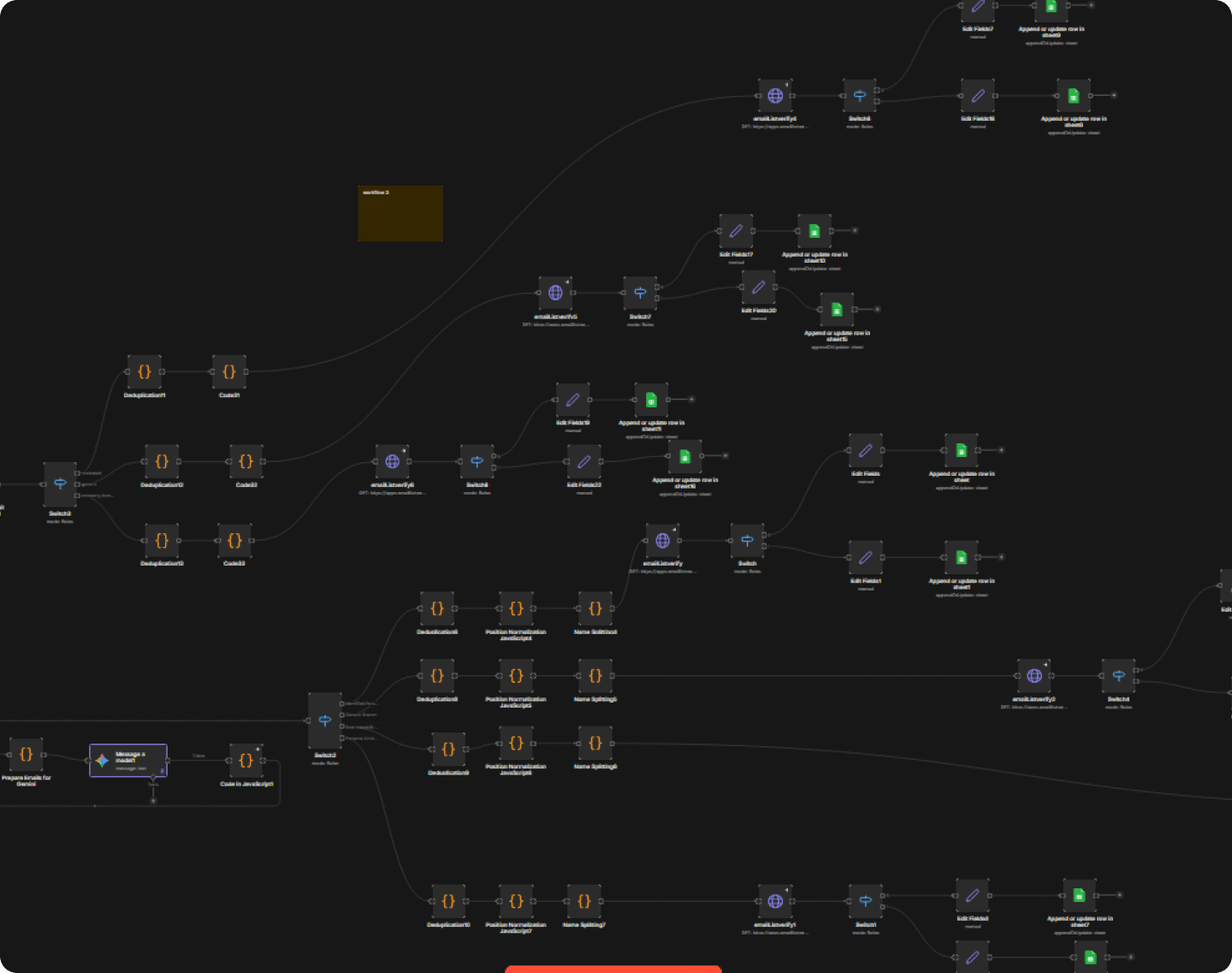
How Hot Inbox Built an Operational Lead Pipeline Designed for Scale
25,000+leads per day
n8n-poweredworkflow orchestration
Production-readyagentic infrastructure
FAQ
Common questions about agentic systems
Automation follows the rules you set up front, with the same input and steps, every time. An agent reasons about a goal, makes decisions, and adapts to what it finds. Most production systems end up using both, automation where the path is predictable, agents where judgment is needed.
If it only works when the input looks exactly like your test cases, it's not there yet. Production-ready means it holds up under messy inputs, stays stable through integrations and monitoring, has fallback logic when something breaks, and behaves consistently once real people are actually using it.
We start from the operational problem. From there, we map out which workflows the system should own, design the architecture around them, and integrate it into the tools your team already uses.
Most systems go from discovery to deployment in 3 to 8 weeks. Where you land in that range depends on how complex the workflow is and how many integrations it needs.
n8n is great for automating a defined workflow. A proper agentic system goes further, adding AI agents, retrieval, monitoring, and fallback logic so it can handle situations the workflow wasn't explicitly built for.
Once a workflow becomes operationally critical, or needs multiple integrations and long-term reliability, that's usually when it's worth bringing in a specialist instead of building it in-house.
Ready to talk about
what you're building?
Book a 30-minute call and come as you are. No preparation needed on your end.
Book a Discovery Call